

 InfoSearched
Samsung just bent the rules of what a gaming monitor can look like.
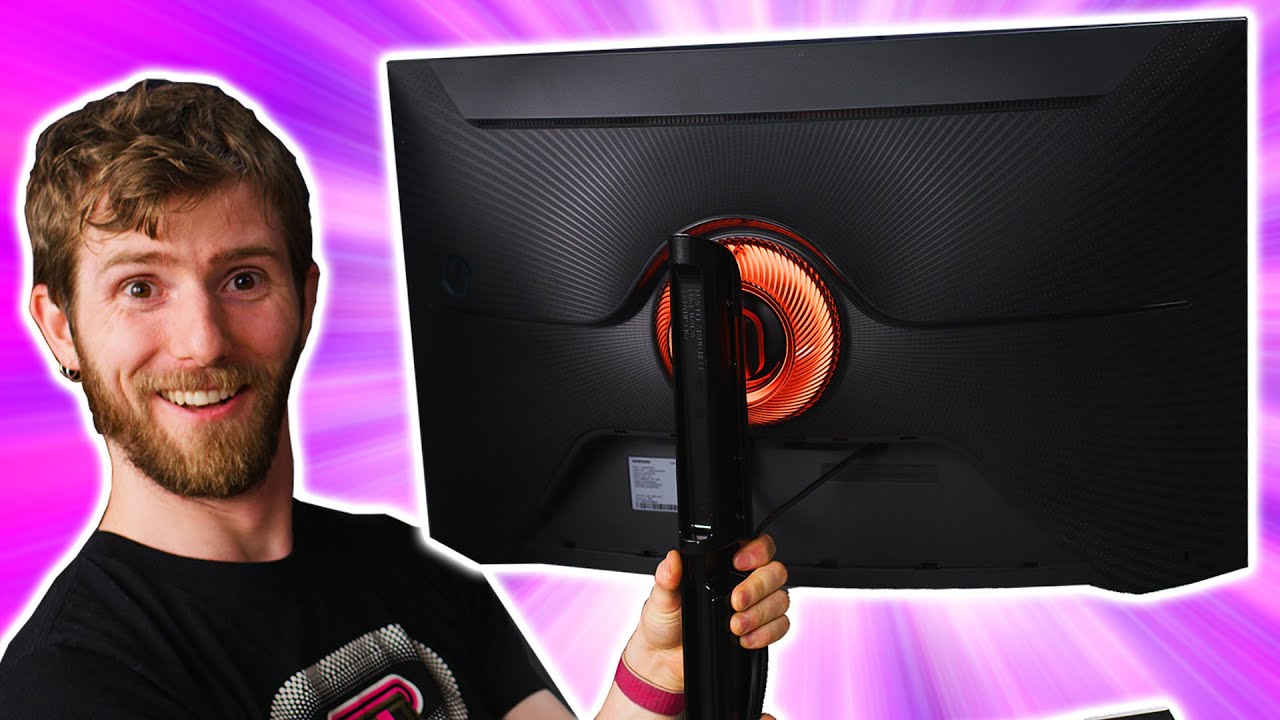
A crate marked straight from Samsung landed at the ShortCircuit office, and inside was the Odyssey G7 — a monitor built around a curve so aggressive that no display maker had shipped anything like it before. The unboxing and hands-on run doubled as a real-world check on whether Samsung’s spec sheet actually holds up once the panel is plugged in and pushed with real games.
- The Odyssey G7 pairs a 1000R curvature with a 240Hz refresh rate, 1ms response time, and a 2560×1440 QHD VA panel using Samsung’s QLED quantum-dot tech.
- It ships in 27-inch and 32-inch sizes and carries TÜV Rheinland certification for Eye Comfort and its high-performance curve.
- VESA DisplayHDR 600 certification puts peak brightness at up to 600 nits, and the panel supports Adaptive Sync plus Nvidia G-Sync Compatibility over DisplayPort 1.4.
The 1000R Curve Innovation Explained
Most curved gaming monitors on the market top out around 1800R, a gentler bend that’s noticeable but not dramatic. Samsung went far tighter with 1000R on the G7 — the same radius Samsung uses on some of its curved TVs — which wraps the edges of the screen closer to the viewer’s peripheral vision. Samsung debuted the spec at CES 2020 as part of its broader Odyssey gaming lineup, and the G7 was the version built to prove the curve could work at competitive framerates rather than just cinematic ones.
In the ShortCircuit setup, that curve is paired with a matte-black chassis, front-bezel lighting accents, and a customizable rear lighting orb Samsung calls its core lighting design — details meant to make the G7 look as aggressive sitting on a desk as it plays. It’s the kind of aesthetic push Samsung has also carried into its larger Odyssey siblings, including the ultrawide Odyssey G9.
The Numbers That Matter for Competitive Play
240Hz and a 1ms response time are the two specs that matter most to anyone playing shooters or fast-paced esports titles, and the G7 hits both on a VA panel — historically the slower panel type prone to ghosting. Samsung’s pitch is that the G7’s fast VA implementation closes that gap while still delivering VA’s stronger contrast and blacks compared to a typical IPS panel.
QLED quantum-dot tech backs the 10-bit color output, and VESA DisplayHDR 600 certification means the panel can hit up to 600 nits at its brightest — enough to make HDR-enabled games look genuinely bright rather than just technically “HDR compatible.”
1000R curvature, 240Hz, 1ms response — specs that, until the G7, nobody had managed to put on the same panel at once.
Adaptive Sync and G-Sync Compatibility in Practice
The hands-on run put real weight on whether Adaptive Sync and Nvidia G-Sync Compatibility actually eliminate tearing at high framerates over DisplayPort 1.4, rather than just checking a box on a spec sheet. That’s the practical test for any 240Hz monitor — sync technology that falls apart under variable framerates defeats the purpose of the panel’s speed. Samsung built the G7 to run that sync smoothly whether the frame rate is locked at 240 or bouncing around during a demanding scene.
Anyone assembling a desk around a panel like this is usually deep into the rest of their setup too — a mechanical keyboard, a gaming mouse, and the kind of gaming accessories that round out a build meant to actually use a 240Hz refresh rate rather than waste it.
PBP and PIP for More Than Gaming
Beyond the gaming-first specs, the G7 includes Picture-by-Picture and Picture-in-Picture modes, letting it display two separate source inputs at once. That’s a feature aimed squarely at people who split their time between gaming and content work — editing footage next to a reference clip, or running a stream overlay next to gameplay — without needing a second monitor on the desk.
Samsung positioned the 27-inch and 32-inch G7 as the mid-tier entry point into its Odyssey curved lineup, sitting below the even more extreme ultrawide G9. Whether the 1000R curve becomes the new standard or stays a Samsung signature comes down to how quickly the rest of the monitor market tries to match a 240Hz panel that tight.





Cool Gaming Accessories Under $25 | Ep1
CYBERPUNK 2077 NEW Gameplay Demo 20 Minutes 4K
Xbox Game Pass Update | 8 NEW TITLES Added | May & June 2019
Top 10 Best Video Game Launch Titles | The Completionist
30 BIGGEST Games To Look Forward To At E3 2019