

 InfoSearched
Five video game maps make Planet Earth’s 197 million square miles look like a rounding error.
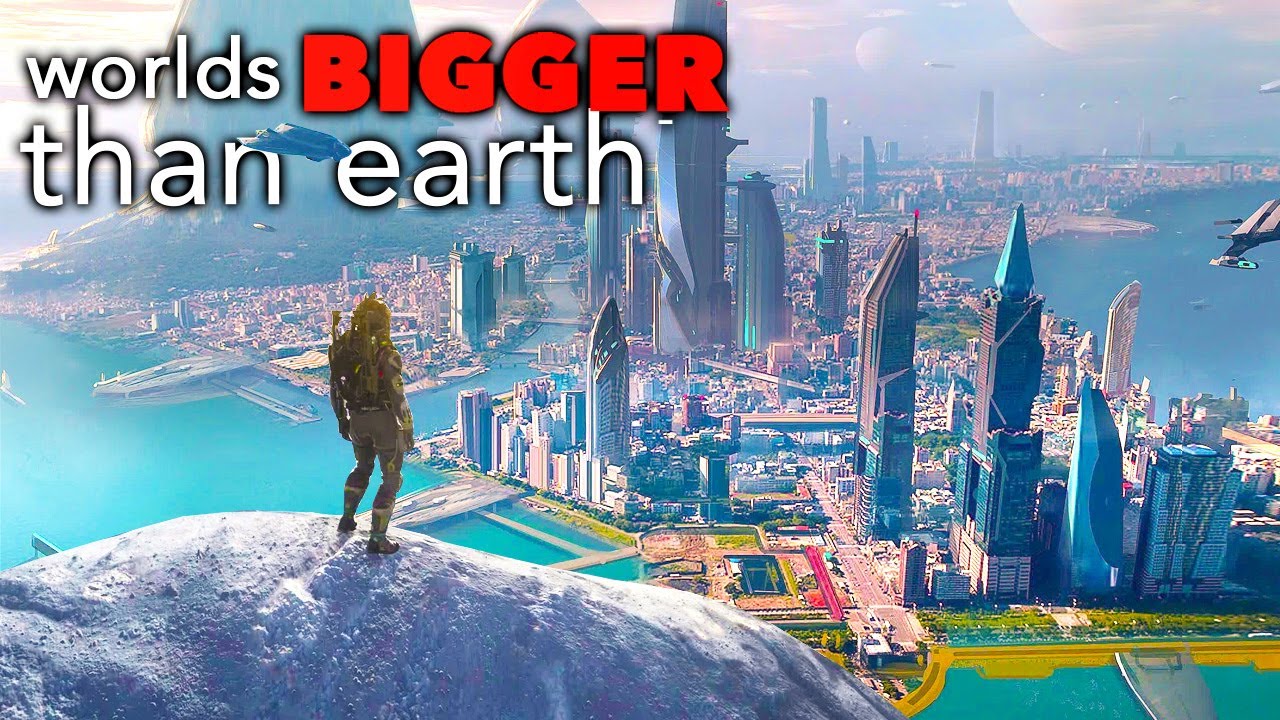
Gameranx’s “5 Game Worlds BIGGER Than Planet Earth” skips past the usual suspects — Grand Theft Auto, Skyrim — and goes straight for the games where procedural generation and space-sim math produce numbers too large to sanity-check. The video breaks down exactly how developers built worlds that outsize the real planet, sometimes by factors that don’t even make intuitive sense once you start doing the arithmetic.
- No Man’s Sky’s procedurally generated universe contains more than 18 quintillion planets spread across 256 galaxies, effectively making it unexplorable in full.
- Elite Dangerous recreates the Milky Way at 1:1 scale, home to roughly 400 billion star systems.
- Minecraft’s procedural terrain generation limits produce a playable map surface that dwarfs Earth’s actual square mileage multiple times over.
No Man’s Sky’s Numbers Don’t Really Work As Numbers
Hello Games’ No Man’s Sky is the anchor of the list for a reason: 18 quintillion planets isn’t a marketing exaggeration, it’s the literal output of the game’s procedural algorithm across 256 galaxies. Every planet gets its own terrain, weather, flora, and fauna generated on the fly rather than hand-built, which is the only reason a number that large is even possible to ship on a disc. Gameranx frames it plainly — no player, no community of players, no server farm of bots could ever set foot on more than a sliver of what’s technically already “there.”
Elite Dangerous Recreates An Actual Galaxy
Where No Man’s Sky invents its universe from scratch, Elite Dangerous tries to model a real one. Frontier Developments built the game around a 1:1 scale version of the Milky Way, populated with roughly 400 billion star systems drawn from actual astronomical data. That scale is why the game’s interstellar travel systems exist at all — without a supercruise and jump-drive mechanic, crossing even a fraction of that galaxy at sublight speed would take longer than most players’ lifetimes.
400 billion star systems, modeled at true galactic scale — and that’s before anyone starts talking about No Man’s Sky’s 18 quintillion planets.
Minecraft’s Blocky Terrain Still Outscales The Planet
It’s easy to underestimate Minecraft next to space sims, but Mojang’s procedural terrain generator has technical limits far beyond what any single world file ever actually uses — and those theoretical limits stack up to a surface area that beats Earth’s roughly 197 million square miles several times over. The video’s point isn’t that anyone has walked that terrain; it’s that the generation engine is capable of producing it, block by block, indefinitely in every direction a player chooses to travel.
Benefits of Procedural Generation for Developers
The throughline across the video’s picks — No Man’s Sky, Elite Dangerous, and Minecraft, alongside space sandbox Star Citizen — is that none of these scales were hand-authored. Procedural generation lets a small studio like Hello Games ship a universe that would be physically impossible to design manually, trading hand-crafted detail for sheer, almost incomprehensible scope. Gameranx’s breakdown treats that trade-off as the real story: bigger doesn’t always mean better-designed, but it does mean these games have redefined what “open world” is allowed to mean.
No Man’s Sky has kept expanding since launch through free updates, and Elite Dangerous players are still finding star systems nobody’s bothered to chart. Eighteen quintillion planets is the kind of number that guarantees somebody, somewhere, is always going to be the first person to land on one.








Esports: Inside the relentless training of professional gaming stars
90-year-old Japanese grandma flexes fingers for video gaming
Brands With Best-Selling Video Game Consoles 1972 – 2019
Pro-Gamer Builds Epic Tiny House With Crazy Computer Set-up
Weirdest Gaming Tech You Can Only Buy In Japan