

 InfoSearched
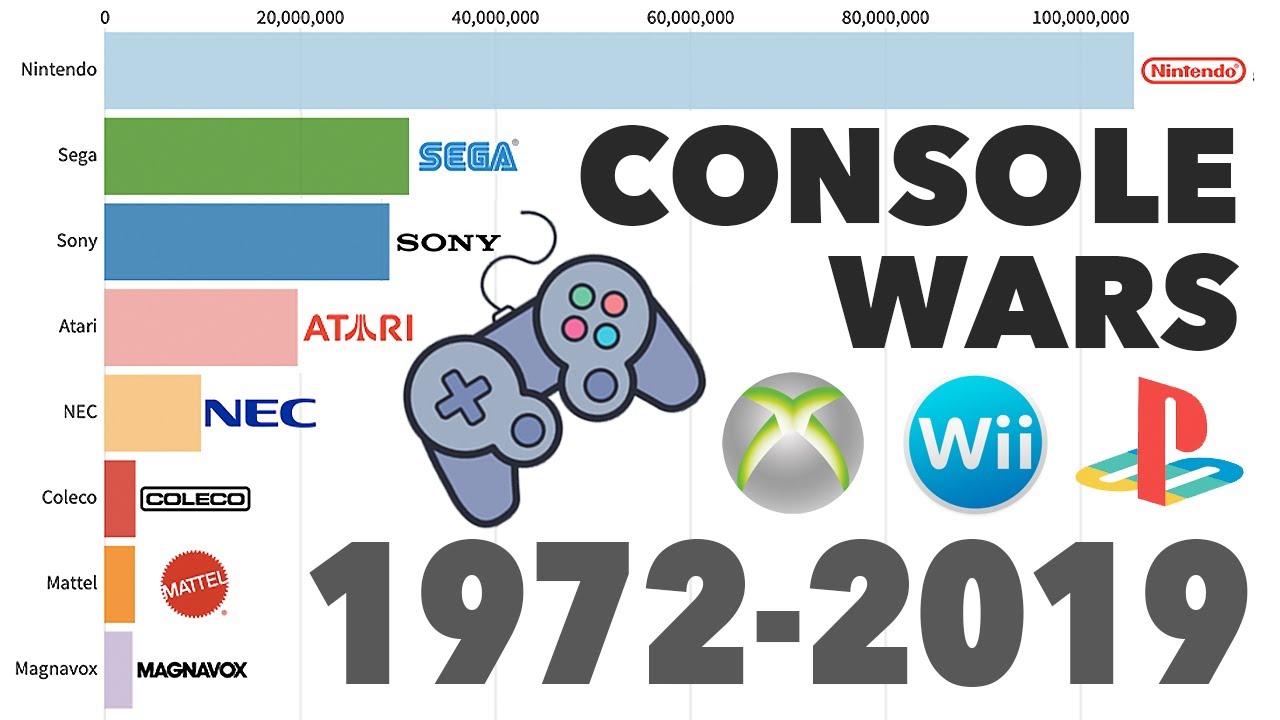
Four decades of console wars, boiled down into one animated bar chart — from a $99 Magnavox box in 1972 to a PlayStation 2 that’s sold north of 155 million units.
Captain Gizmo’s data visualization “Brands With Best-Selling Video Game Consoles 1972 – 2019” tracks cumulative global hardware sales across nearly every major platform holder in the industry’s history. The bar-chart race compresses roughly two-thirds of all console unit volume worldwide — everything but the minor plug-and-play clones — into a single animated timeline running from Ralph Baer’s Magnavox Odyssey through the Nintendo Switch’s 2019 numbers.
Watching the bars swap positions generation by generation tells a story the sales figures alone don’t: a market that crashed in 1983, got saved by a Japanese toy company, and then got upended twice more by a computer peripherals brand and a software giant with a hard drive to sell.
- The Magnavox Odyssey launched in 1972 at $99 (about $600 in 2019 dollars), making it the very first home console tracked in the video’s data.
- The PlayStation 2, launched at $199 in 2000, has sold more than 155 million units — still the best-selling console of all time by the chart’s numbers through 2019.
- Nintendo’s Switch had reached roughly 40 million units sold by the end of 2019, making it Nintendo’s fastest-selling console to date at that point.
The Cartridge Era Takes Shape
Before ROM cartridges existed, Atari’s home version of Pong (1975, $99) and Coleco’s Telstar (1976, $99) were essentially single-game arcade boxes wired into the living room television. That changed in 1977 when Atari released the 2600 Video Computer System for $199 ($860 adjusted), the console that made swappable cartridges the industry standard. Magnavox answered with the Odyssey 2 in 1978 ($179), and Mattel followed with the Intellivision in 1979/1980 at $299 — a steep $1,110 in 2019 terms.
The 1983 market crash nearly wiped the category out before Coleco’s ColecoVision (1982, $175) pushed graphical fidelity forward, directly influencing what came next. Nintendo’s Famicom launched in Japan in 1983 and arrived stateside as the Nintendo Entertainment System in 1985 at $179, single-handedly reviving a market everyone assumed was dead. Sega entered the fray at the tail end of 1986 with the Master System at $199.
The 16-Bit Showdown and Sony’s Entrance
NEC’s TurboGrafx-16 hit shelves billed as the first 16-bit console — even though it technically ran on an 8-bit chip — at $249. Sega’s Mega Drive followed in 1988, rebranded as the Genesis in North America for $189, and Nintendo answered with the Super Famicom in Japan before launching it stateside as the Super Nintendo in 1991 at $175.
Everything shifted in 1994 when Sony, a company with no console pedigree, dropped the 32-bit PlayStation at $299. It arrived a month after Sega’s Saturn ($399) and eventually outsold both the Saturn and Nintendo’s cartridge-based Nintendo 64 ($199, released 1996) by staggering margins.
The PlayStation 2 alone has moved north of 155 million units — a number no console before or since has come close to touching.
Sony’s Dominance and Microsoft’s Arrival
Sega’s Dreamcast ($199) became the first sixth-generation console but also the company’s last piece of hardware. Sony’s PlayStation 2, launched in 2000 at $199, became the best-selling console in history and hasn’t been dethroned since. Microsoft entered the business entirely in November 2001 with the original Xbox at $299, going head-to-head against a GameCube that had launched a couple of months earlier at $199.
Microsoft moved fast, releasing the Xbox 360 just four years later at $299. Sony’s PlayStation 3 followed at a hefty $499 launch price — reportedly sold at a loss of roughly $240 per unit — before a slimmer, cheaper PS3 arrived in 2009 for $299.
The Modern Generations
Nintendo’s Wii, at $249, became the company’s best-selling console ever with more than 100 million units moved, largely on the back of motion controls that pulled in non-traditional gamers. The follow-up Wii U flopped by comparison, moving just over 13 million units at $299 and becoming Nintendo’s worst-selling home console.
The Xbox One launched in 2013 at $499 as a self-described all-in-one entertainment box, the same year Sony’s PlayStation 4 debuted at $399 and went on to sell 102 million units. Sony added 4K and USB 3.1 support with the PS4 Pro in 2016, while Microsoft answered with the Xbox One X in 2017 at $499, adding native 4K and FreeSync. By 2019, the Switch’s 40 million units made it the fastest-selling console in Nintendo’s history to that point.
By the time the chart’s data closes out in 2019, Sony and Microsoft were both openly teasing their next machines — the PS5 with its overhauled DualSense controller and the Xbox Series X with its promises on load times and horsepower. Whichever one of those posts bigger year-one numbers, neither is catching the PS2’s 155 million-unit head start anytime soon.

No Man’s Sky Beyond – Launch Trailer | PS4
Top 10 NEW UBISOFT Games of 2020 & 2021
Sony Confirms More Studio Acquisitions | PS4 Is the 2nd Best Selling Console of All Time
GameStop TV | July 2019 | PC Gaming Accessories
CAN YOU BUILD A MAC GAMING RIG???